A View from the Gallery

Using the classic French epergne as a centerpiece for the dining table

April 28th, 2012

This classic French epergne serves as the focal point of a simply elegant table.

Even the most simple table setting can transform an ordinary meal into a memorable occasion. Here, we are emphasizing sparkle rather than color: The silver and the cut crystal catch shimmers of light that add atmosphere. Set plain white china on lace placemats; add a salad plate with a floral motif and a plain white napkin gathered into a fan with a silver antique napkin ring and more crystal glassware for added sparkle.


The piece de resistance, however, is the epergne. Originally a serving piece in the well-to-do homes of France, the multi-level piece now is more decorative than utilitarian. This one combines silver and glass, and it features putti – little cherubs that are always good for a smile. We salute spring with blossoming dogwood limbs in the vase section and plump artichokes in the bowl for a pop of color, but any kind of fruits or veggies or flowers will work.


While we’re always looking for new ways to use old pieces, we’re going to suggest that you use the epergne much like the historic French did: as a serving piece for a party. Many epergnes incorporate the central cylinder with bowls that hang at different levels. The French filled the bowls with side dishes and pastries. For a party, consider using the epergne as an interesting way to present fruits or cheeses. However you use it, the epergne will add sparkle to the event.


Again, we’ve used old and new. The white casual dinnerware? New. The water glass? New. The floral plates are antiqueLimoges, and the white wine, red wine, and compote are antique crystal, as are the napkin rings. The lace placemats are new, but they add a warm feeling from your grandmother’s dining room. All the pieces work beautifully together.


To be sure, we have filled the table; however, the effect is simple. It relies on the glow of candles and soft lighting to enhance the beauty of the food that is served.


Back to epergne: Just how do you say that word? It’s pronounced “a-pern.” It’s simple – just like our table.


Red, white, blue — and you!

April 19th, 2012

Red, white, and blue combine for a festive tablesetting.

We love blue and white. We love tulips. We love combining the two to create a festive tablescape.

Blue and white porcelain first was seen in the days of the early Chinese emperors, who showed a deep appreciation for objects of beauty. The discovery that an abundant plant produced the blue color capable of permanently dyeing pottery opened the door to artistic creativity. The color combination is always fresh and goes with any decor; hence, its ageless appeal.

Tulipieres come in a variety of shapes, sizes, and colors. We found these lovely pagoda-style pieces and fell in love at first sight. We knew they would be perfect for our spring table.

To create our setting, we have used new pierced ceramic chargers in white with antique blue-and-white china. We added the new tulipieres on either side of an antique Chinese basin filled with moss-covered orbs to add center interest without interfering with the natural lines of conversation that are bound to occur over dinner.

Finish the look with red napkins, contemporary-style martini glasses and cut lead crystal in both red and blue (ours is Baccarat), and you have the perfect French-inspired table.

French-inspired? With all the Asian pieces?

Absolutely.

The French embraced Asian style in the earliest days of the country’s royalty. And where do you think the American patriots got the idea to use red, white, and blue as the symbol for the United States? From the French revolutionists, who used the colors to represent liberty, fraternity, and equality — three concepts that work together to create a lovely evening over dinner with friends.


A beloved British home decor object

April 12th, 2012

These little ceramic doggies are fashioned after the Cavalier King Charles Spaniel. (Photos by Keith McCoy)

Those adorable little pottery dogs aren’t the only home decor objects that carry the name “Staffordshire.”

You can also find lions and tigers and bears! Oh, my!

And let’s not forget about figures of lords and ladies in a variety of lord and lady poses.

Staffordshire dogs are among the most popular. Fashioned after the royal Cavalier King Charles Spaniel (yes, King Charles of England loved the little dogs), the fired clay figures have been around since the 18th century — often by farmers trying to supplement their income.

Like the spaniels, the Staffordshire version comes in a variety of colors.

The Staffordshire part of the name reflects the area of England where the pottery was made. Six towns in the middle region of the country — Burslem, Fenton, Hanley, Longton, Stoke, and Tunstall — were best known for producing tableware as well as decorative objects from the abundant clay found in the region. (An interesting aside: The term “pot hole” comes from the practice of these early potters digging up roads for the clay. The roads had been cleared of brush, so it was an easier way to get the clay.)

Staffordshire isn’t a specific brand, although several well-known companies still in business today started in the regional pottery business: Wedgwood, Spode, Minton, Aynsley, Doulton, and Twyford.

The Victorians especially loved the dogs and other Staffordshire figures. In fact, most of the antique Staffordshire we get today is from the 1840’s through the 1890’s. Reproductions also are abundant, but it’s nice to know that collectors still can find really nice pieces from the 19th century.

Staffordshire pottery comes in a variety of subject matter. On the right is a depiction of Little Red Riding Hood; the others are of courtly figures.

At Clark Antiques Gallery, you’ll find a variety of Staffordshire pottery: The dogs (of course), a pair of lions, and several courtly figures.

This pair of lions is just as adorable as the dogs but much harder to find.


We are ‘multitudes”

March 18th, 2012

As you get to know us better, you’ll realize that while we love to be surrounded with beauty, we believe that balance and comfort are the keys to creating sanctuary.

You’ll see the phrase “casual elegance” on a regular basis, and you’ll begin to understand why we love the French Country style so much. It’s a style of decorating that  combines furniture and fabrics to reflect an attitude of quiet free from the cacophony we all experience in the world outside our doors.

The look is relaxed yet sophisticated, a la Coco Chanel. It can be formal without being fussy.

French Country style allows the mixing of a fine family antique with a loved contemporary piece, for example. It allows both curved lines and straight to co-exist peacefully. It allows patterns and plaids to mingle; it allows soft gathers to complement stiff textiles.

Whether you lean toward the rustic or the refined, you can achieve that comfortable, casual elegance simply by gathering the things you love in one room. Don’t be afraid to mix and match periods of furnishings, fabrics and accessories.

Walt Whitman wrote in Song of Myself, “Do I contradict myself? Very well, I contradict myself. I am large; I contain multitudes.”

We all “contain multitudes”; we encourage you to embrace yours.

Art blooms at the gallery

March 14th, 2012

March is an especially artistic month for Clark Antiques Gallery.

In general, we enjoy wall art, table art; we love large art, small art; we thrive on interesting art, unusual art.

This numbered and signed lithography by Alexander Caulder is an example of the type of art that Walter Edelman will bring to Birmingham later this month for his show at Clark Antiques Gallery.

Walter Edelman represents the estate of Salvador Dali. This untitled lithograph may be available for sale when the art dealer visits Birmingham March 27-28

We have all kinds of art at the gallery, but on March 27th and 28th, we’ll have international art — brought to us by third-generation art dealer Walter Edelman.

Edelman represents more than 200 artists around the world as well as the estates of Marc Chagall, Salvador Dali, and Pablo Picasso. He’ll bring hundreds of pieces to the gallery for a special show and sale on these two days, with prices ranging from $50 to $50,000 and higher.

This man is a walking encyclopedia of art and art history. Visit the gallery on March 27th and 28th, and you’ll get as many “mini” lectures on specific works of art as you’d like.

Become a frequent visitor to our website and Facebook page during the next couple of weeks for more details on the Edelman fine art show.

In the meantime, check out the story written about Edelman’s visit last summer; you’ll be fascinated. Here’s the link: http://blog.al.com/living-news/2011/08/art_dealer_walter_edelman_brin.html.

Old and new — and you!

February 14th, 2012
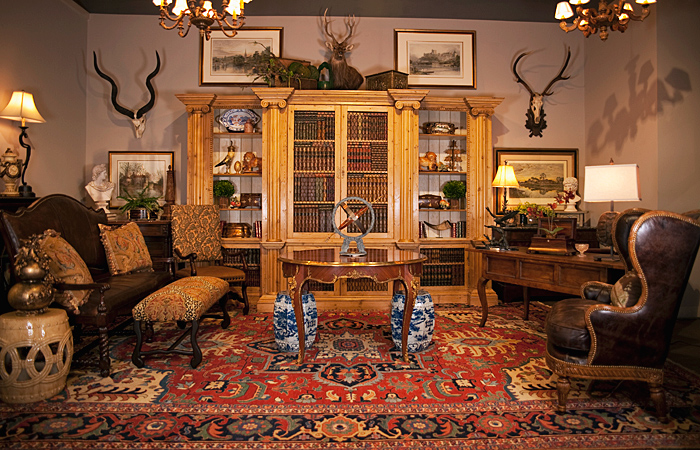
Who says antiques can’t mix with contemporary pieces? Certainly not us, and this photo proves that new and old combine Who says antiques can’t mix with contemporary pieces? Certainly not us, and this photo proves that new and old combine beautifully. This Italian pine breakfront, circa 1900, is the perfect anchor for a family room, a dining room, or a library.

Add a pair of 2012 wing chairs in a pinstriped burned velvet with nailhead trim, and you’ve got the beginning of a wonderful, comfortable room. Thinking dining room? Use the wing chairs as host and hostess chairs.

Now for more generational style: The leather settee from France and the English George III leather chair (signed by the designer), circa 1860, look pretty cozy gathered pulled up to a couple of 2012 linen ottomans perked up with a definite Moroccan flair.

We have filled the breakfront with blue-and-white collectible pieces as well as a piece or two of Imari porcelain. The piece could just as well hold trophies or family photos. Perhaps adding heirloom (or casual) china is a better choice for you. And books — all kinds of wonderful books — would be right at home.

By the way, do you know why this piece is called a breakfront? Because the front is not even; the center juts out a bit.

This room works because the colors and scale complement each other. We love to mix the past and present; we love to mix countries.

In short, we love to break the rules;  after all, there really are no rules.  It is all about placing your treasured pieces in a fashion that makes them functional, but enjoyable — and more importantly — the way you love to see them.

After all, you are creating your sanctuary.

Make every meal special; make every room special

February 8th, 2012


This setting will make the most casual meal special.

When it comes to style, the French really do get it right. They know that no one has a single way of dressing or decorating. Our homes are as complex as we are.

Perhaps that’s why we love French Country so much. It isn’t a single style; it encompasses many styles — rustic, refined; casual, elegant — and it incorporates those styles seamlessly in a single room.

It’s almost magic. For sure, the result is a magical room.

We Americans have a lot in common with the French. For one thing, we all like to eat — and we like to eat in a nice setting. We put this vignette together to give you some ideas on how to dine casually in style. For example, this antique French farm table is perfect for a not-so-formal meal. We have mixed textures and styles of glass and dinner ware: Formal and informal crystal mimics the colors …in the Majolica salad plates that top embossed stoneware. A swath of burlap adds a rustic touch. But we don’t stop there: An antique needlepoint bench and a contemporary armless settee co-mingle comfortably.

Like the French, Americans also enjoy using furniture pieces in unexpected ways. We’ve given you one example here with the seating. But think about how the table can be used in other parts of your home: As a foyer table, perhaps, topped with our French Anduze planter seen in the photo and a pair of lamps; as a game table in a den; or as a library table, perfect for studying or reading. The antique needlepoint bench would be lovely situated at the foot of a guest bed or lining a hallway, while the contemporary settee could offer extra seating on movie night, or again, nestled at the foot of a queen or king bed.

Whether you live in a rambling house in the country or a condo in a highrise, you can take a lesson from the French: Mix what you love with what you need, then add a healthy portion of family heirlooms. Don’t worry about whether everything “matches”; that’s boring. And the French are anything but boring.

Let your rooms evolve as if the final result took years. That’s exactly what the French would do.

Enjoy a meal, a la French Country

January 20th, 2012

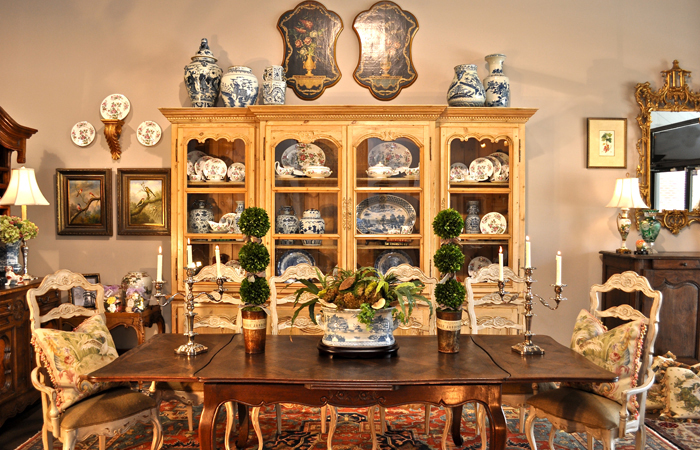
We've upholstered lightly gilded chairs in nubby burlap and set them around a Sheraton mahogany dining table. A grouping of framed botanicals and bird tapestries hangs above our oak Louis XV-style enfilade with a parquet top, c. 1895. To the left stands a French country buffet a deux corps in solid walnut, c. 1880.

One of the reasons we love French Country style so much is due to its casual elegance.

Nothing looks or feels like it’s brand new, even if it just came off a showroom floor. It’s comfortable, and it’s anything but fussy.

That’s why a French Country dining room works so well. You and your guests can feel comfortable sitting at a table topped with burlap and crystal. The juxtaposition of the rough and smooth, the rustic and refined works. We can enjoy a formal, multicourse meal at such a table and never once feel nervous that we may be using the wrong fork.

When setting the table, don’t worry so much about whether all the dishes and flatware match in terms of pattern. It’s imperative that the items are of good quality, however. Use estate silver or silverplate and heirloom china for that comfortable, carefree look.

For a table that’s distinctly French, cover the food with a cloche and add pots of herbs to the setting. Be sure to keep pitchers of wine and water ready for refills.

The key is to make everything from the food to the room setting effortless. Both you and your guests will enjoy your time together.


It’s time to think about change

January 19th, 2012

Our Louis XVI-style settee draws fresh energy from a mix of four coordinating fabrics in sunflower, butter and, and gray tones. A black-and-gold lamp tops a Louis XVI-style, marble-topped side table, c. 1900.

A new year. A new perspective. A new look.

Spend the dull days of January and February walking through each room of your home, taking stock of each piece of furniture, each rug, each lamp. What color are the walls? What do you love, really love? What can you live without?

Be honest. Be critical. After all, this is your home, your sanctuary — and you want it to look, and feel, its best. As you evaluate each room, consider simple changes that can make a big difference. Look at the decorating trends, and incorporate the things you love.

Here are some of the trends we like:

— Reuse, repurpose, recycle. Add a piece of iron — in a lamp base, for example — to your decor to incorporate the industrial look. An antique armoire finds new life as it houses your TV or displays your china.

— Celebrate nature with framed botanicals, bird prints, and natural fibers.

— Add European romance with carved furniture and distressed finishes.

Painted birds adorn an Asian three-panel metalllic screen above this intricately carved, Louis XVI-style bleached four-drawer oak commode, c. 1860.

— When displaying art, think big. Use one large piece or a grouping of many smaller ones, using black-and-white photography or drawings, or colorful modern art.

— Lighten up. Add a piece of bleached furniture. Try a metallic finish on a piece to give it pizazz.

— Use grays and other neutrals as your decorating base. Add a pop of color with textiles — yellow, indigo, grass green, or orange — either in textured solids or oversized prints.

Remember, do not skimp on any room. Give each one equal attention. After all, this is your sanctuary.

NOTE: The photos shown here simply offer an example of how you can combine fabrics and wallpapers in complementary colors to create a balanced and beautiful room. 


Your home. Your sanctuary.

November 19th, 2011


Antique pine farm table and benchA sanctuary, by definition, is holy space: Set apart, private, and deeply personal.  At Clark Antiques Gallery, the concept of sanctuary informs everything we do, from the pieces we bring into the gallery for sale, to the principles of design we apply to our gallery’s displays and our clients’ homes, to the way we treat each new person who walks through the gallery’s door.

We’ve tried to make our showroom a sanctuary, a place where you can rest and refresh and feast your eyes on Louis XV-style walnut bergerebeautiful  things … but there’s nothing more appropriate and holy for you than whatyou can find in your own home. Look around you. What speaks to you most?

Is it the well-worn farm table where your family gathers for the evening meal?  The cozy bergere where you snuggle with your toddler each morning and read a book?  A painting or print that you chose because it inspires you, and not because it matches your sofa?  (Though we think it’s okay if it matches your sofa.)


antique oil painting on canvas, bicycle in doorwaySurround yourself with the furniture and accessories that bring you joy, that call up happy memories or make your heart sing, and your home will be just-right for you, your holy space.  Your own eye for detail, and your own private dreams, will determine your direction.  If you’re comfortable working with an interior designer or decorator, he or she can help you create an environment that meets the specific needs of your family.  An outsider’s perspective can help you make the most of the pieces you already love, and the right designer will bring in new furnishings that will someday become your children’s heirlooms.

Stop by our gallery and see our vision of sanctuary.  Share your vision with us.  Find something new and lovely you can make your own.  And always, always, cherish what you already have.  It is yours, and it is holy.